 Loading Please Wait...
Loading Please Wait...
Loading Please Wait...
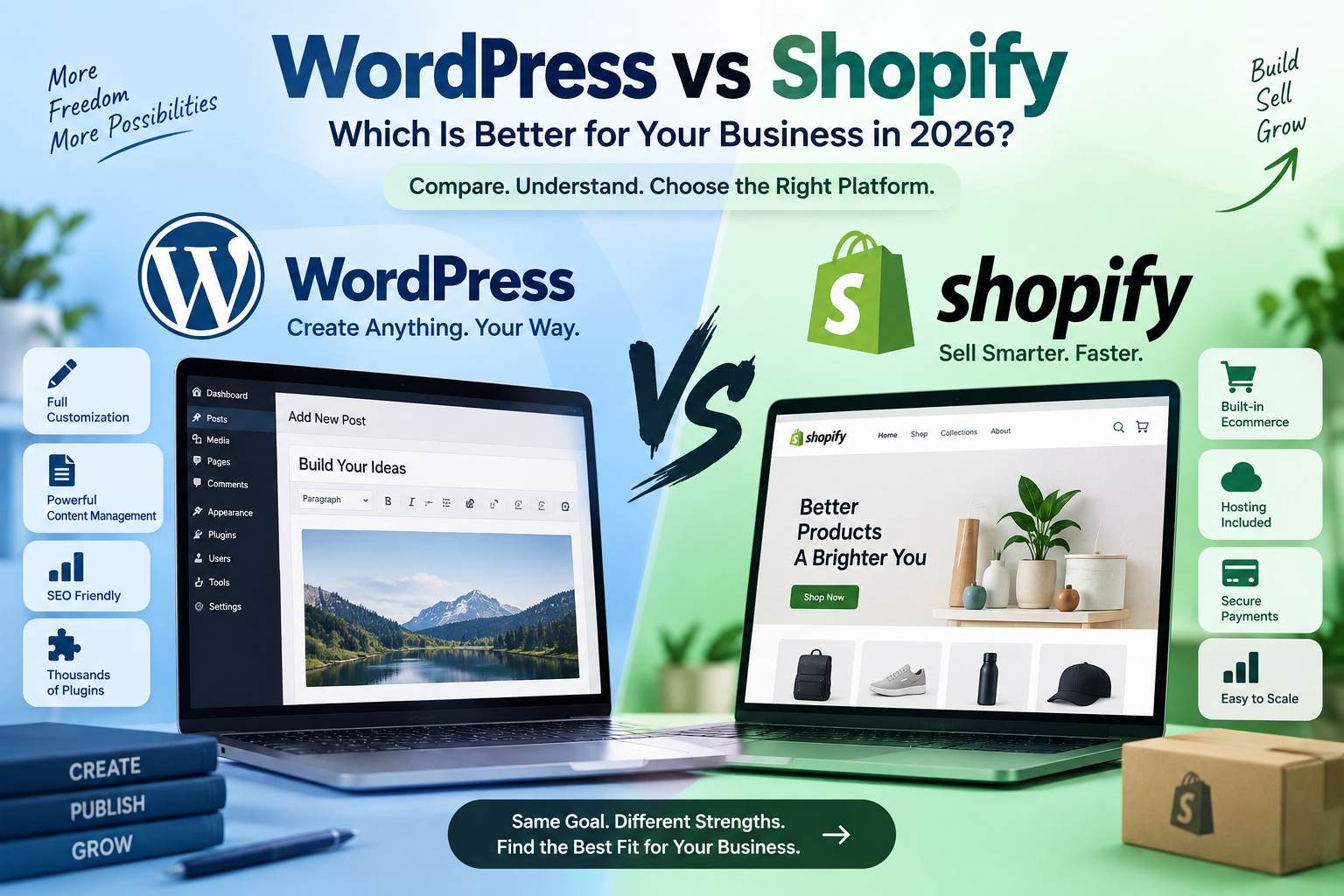
Choosing the right platform for your website can affect how easily you manage content, sell products, improve SEO, and grow your business. Two of the most widely used options are WordPress and Shopify, but they are built with different priorities in mind.
WordPress is known for its flexibility, content management capabilities, and extensive customization options. Shopify, on the other hand, is primarily designed to make ecommerce easier to launch and manage.
So, which platform should you choose?
The answer depends on your business model, budget, technical requirements, ecommerce goals, and the amount of control you want over your website. In this guide, we'll compare WordPress vs Shopify based on the factors that matter most to businesses in 2026.
| Feature | WordPress | Shopify |
| Primary Use | Websites, blogs & ecommerce | Ecommerce |
| Customization | Very high | High |
| Ecommerce | WooCommerce | Built-in |
| SEO Control | Extensive | Good |
| Ease of Setup | Moderate | Easy |
| Hosting | Usually separate | Included |
| Plugins/Apps | Large plugin ecosystem | Large app ecosystem |
| Design Flexibility | Very high | High |
| Maintenance | More hands-on | Mostly managed |
| Best For | Flexible websites and custom requirements | Ecommerce-focused businesses |
WordPress is a flexible content management system that can be used to create business websites, blogs, portfolios, membership websites, and ecommerce stores.
For ecommerce, businesses can use WooCommerce to add products, shopping carts, checkout functionality, payment options, and other online-store features.
One of WordPress's biggest advantages is control. Businesses can customize the website's design, content structure, functionality, integrations, and SEO setup according to their specific requirements.
WordPress can therefore be useful for businesses that want their website to do more than simply sell products.
Shopify is an ecommerce platform designed to help businesses create and manage online stores without dealing with many of the technical requirements associated with traditional website development.
Businesses can manage products, inventory, orders, payments, shipping, and other ecommerce activities from one platform.
Shopify can be particularly useful for businesses that want to launch an online store relatively quickly and spend more time managing their products and customers rather than maintaining website infrastructure.
For businesses where online selling is the main purpose of the website, Shopify provides a streamlined approach to ecommerce management.
Ease of use is an important consideration, especially for small businesses and teams without dedicated technical staff.
Shopify generally provides a simpler ecommerce setup. Many essential features for running an online store are available within the platform, allowing businesses to add products, manage orders, configure payments, and handle other ecommerce tasks from a centralized system.
WordPress can require more configuration. Depending on the project, businesses may need to choose hosting, install WordPress, configure WooCommerce, select plugins, and manage additional technical components.
Shopify may suit businesses that prioritize simplicity, while WordPress can be more suitable when flexibility and control are important.
Customization is one of the major differences between WordPress and Shopify.
WordPress allows businesses to modify themes, plugins, website structures, databases, and custom functionality. Developers can also create features specifically for a business.
Shopify supports customization through themes, apps, APIs, and custom development. However, businesses work within Shopify's platform architecture and technical framework.
If your website requires complex functionality, custom integrations, or a highly specific content structure, WordPress offers considerable flexibility.
Shopify can still provide a highly customized storefront, particularly for businesses whose primary focus is ecommerce.
SEO is important for businesses that want to generate organic traffic through search engines.
Both WordPress and Shopify can support SEO, but they provide different levels of control.
WordPress gives businesses extensive control over areas such as:
This flexibility can be valuable for businesses with a strong content marketing or SEO strategy.
Shopify also supports important ecommerce SEO fundamentals and provides tools for managing products, collections, content, and other store pages. However, some technical elements are handled according to Shopify's platform structure.
For businesses that depend heavily on blogging, content publishing, and advanced SEO customization, WordPress can provide greater flexibility.
When comparing WordPress vs Shopify for ecommerce, the difference becomes particularly important.
Shopify was built around ecommerce. Product management, inventory, orders, payments, shipping, and other store functions are integrated into the platform.
WordPress requires WooCommerce or another ecommerce solution to provide online-store functionality.
This does not mean WordPress cannot support a powerful ecommerce business. WooCommerce can provide extensive functionality and customization. However, it generally requires more configuration and management.
Shopify may therefore be suitable for businesses where ecommerce is the primary purpose, while WordPress can be useful when ecommerce is one part of a larger website ecosystem.
Cost should not be evaluated only by looking at the monthly platform price.
The total cost of ownership can include development, hosting, applications, maintenance, security, and other services.
With WordPress, businesses may need to consider:
Shopify combines many infrastructure requirements into its platform subscription. However, businesses may still have additional expenses for:
The actual cost will depend on the size and complexity of your website and the features your business requires.
Website security and maintenance should be considered before selecting a platform.
With WordPress, businesses generally need to keep WordPress, themes, plugins, hosting, backups, and security configurations properly maintained. Poorly maintained plugins or outdated software can create technical and security issues.
Shopify manages much of the underlying ecommerce infrastructure, which can reduce the technical maintenance burden for store owners.
However, neither platform means that businesses can completely ignore security. Account protection, third-party integrations, applications, content, and website performance still require ongoing attention.
Both WordPress and Shopify can support growing businesses, but they approach scalability differently.
WordPress can be scaled through optimized hosting, caching, database improvements, custom development, and infrastructure upgrades. This provides businesses with considerable control as their requirements become more complex.
Shopify provides a managed ecommerce environment designed to support growing online stores without requiring the business owner to manage the underlying infrastructure.
Your choice should therefore depend on the type of growth you expect.
A content-heavy company with complex integrations may require the flexibility of WordPress, while an ecommerce brand may prefer the managed approach offered by Shopify.
There is no single platform that is suitable for every business.
The most important thing is to match the platform with your actual business requirements rather than choosing based only on popularity.
Yes, businesses can migrate between WordPress and Shopify when their needs change.
For example, a business may initially choose Shopify because it wants a simple ecommerce setup and later move toward a more customized website ecosystem.
Similarly, a business using WordPress and WooCommerce may eventually move to Shopify to reduce the amount of technical infrastructure it needs to manage.
However, migration should be carefully planned.
Depending on the website, migration may involve transferring or recreating:
A poorly planned migration can result in broken links, lost rankings, missing content, or a poor user experience. Creating a migration plan and checking the website after launch can help reduce these risks.
Selecting a platform is only the beginning. Businesses also need the right development, design, SEO, integrations, performance optimization, and ongoing maintenance to get the most from their website.
AllUpNext can support businesses with WordPress development, Shopify development, ecommerce solutions, SEO, digital marketing, and website maintenance.
Whether you need a customized WordPress website or a conversion-focused Shopify store, the platform should be selected according to your business goals, technical requirements, content strategy, ecommerce needs, and long-term plans.
WordPress and Shopify are both powerful platforms, but they are designed around different priorities.
WordPress offers extensive flexibility and customization, while Shopify provides a streamlined environment for ecommerce.
Before making a decision, consider your budget, ecommerce requirements, SEO strategy, customization needs, technical resources, maintenance expectations, and future growth plans.
The right platform is ultimately the one that supports your business goals and gives your team the functionality and control it needs.
If you are still unsure whether WordPress or Shopify is suitable for your business, evaluating your current requirements and future plans first can make the decision much easier.