Logo Loading Please Wait...

Top Tech Trends in India 2026: What Every Business and Developer Needs to Know

Top Tech Trends in India 2026: What Every Business and Developer Needs to Know
24 March 2026

Something shifted in Indian tech over the last two years. The conversations changed. Less “we’re exploring AI” and more “we’re deploying it.” Less “we moved to cloud” and more “we’re rethinking how we build on it.” The experimentation phase, for a lot of Indian businesses, is over.

That’s not hype. India now has the third-largest developer community in the world. The UPI infrastructure processes more transactions in a month than most countries manage in a year. And the startup ecosystem isn’t producing copycats anymore — it’s producing original products. The interesting question in 2026 isn’t whether Indian tech is growing. It’s where the growth is actually happening.

Here’s what’s worth paying attention to.

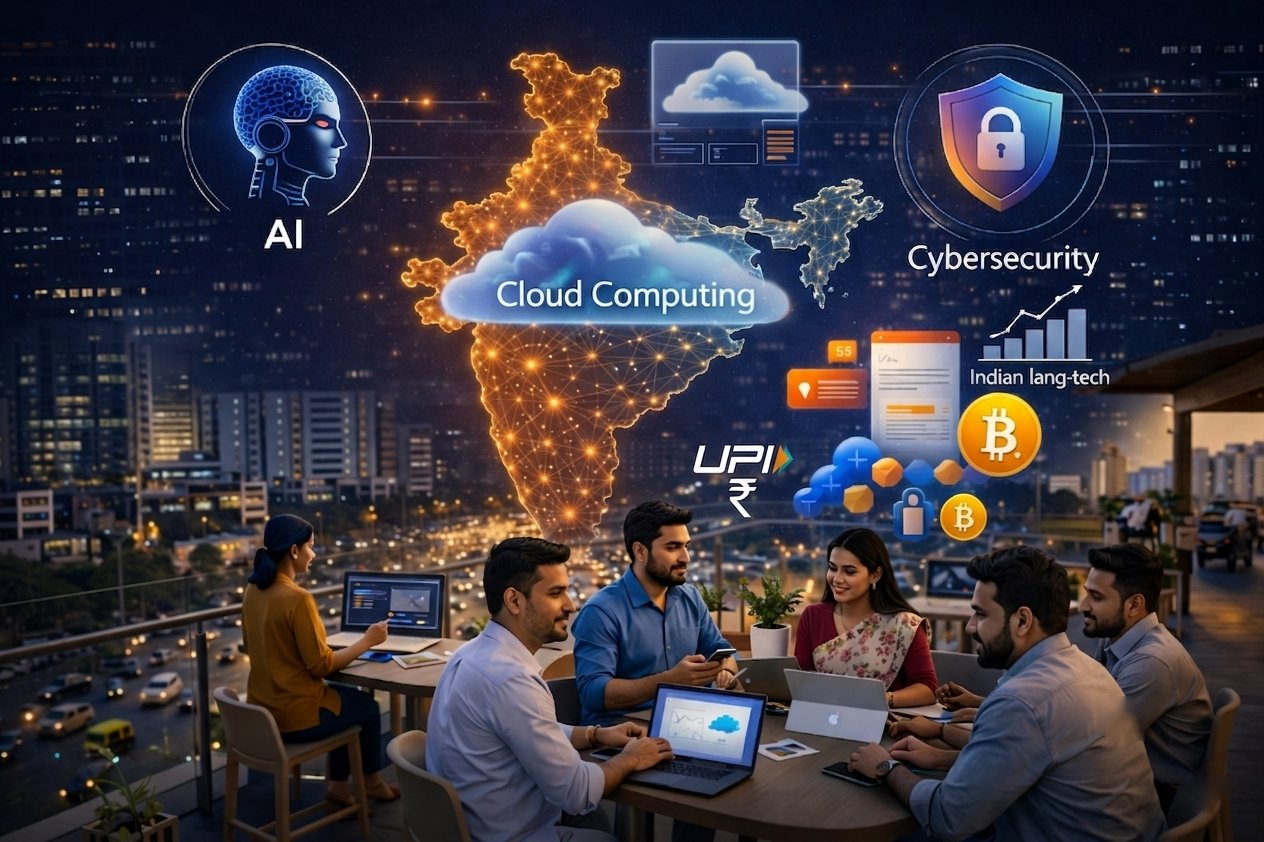
1. AI Is No Longer a Pilot Project — It’s Running in Production

The businesses still “exploring AI” in 2026 are already behind. That’s blunt, but it’s accurate. Companies that moved fast on AI in 2023 and 2024 are now two full years ahead on implementation, data, and iteration.

Where AI is actually working in Indian businesses today:

  • Customer support — not chatbots that say “I didn’t understand that,” but systems that actually resolve tier-one queries; banking, e-commerce, and healthcare have seen the biggest gains
  • Demand forecasting — mid-size companies are using predictive models for inventory and routing that would have been enterprise-only three years ago
  • Document processing — legal and financial firms automating extraction, classification, and verification; the manual effort reduction is significant
  • Personalisation — edtech and e-commerce platforms with recommendation engines that move actual conversion numbers, not just look good in demos

The split is stark. Companies with AI in real workflows are pulling away from those that bolted a chatbot onto their homepage and stopped there. That gap compounds every month.

2. Cloud Has Grown Up — and So Have the Expectations

India’s cloud market was worth over $8 billion in 2025. It’ll double before 2028. But the number isn’t the interesting part. What’s changed is how teams are actually thinking about cloud now versus two or three years ago.

What cloud looks like for serious teams in 2026:

  • Multi-cloud is the default — using AWS, Azure, and Google Cloud together for cost, compliance, and resilience is becoming standard practice
  • Edge and serverless for Bharat — building for Tier 2 and Tier 3 India means solving for inconsistent connectivity; edge deployments are how teams are doing it without rebuilding everything
  • Cloud-native as baseline — Kubernetes, microservices, containerisation; these aren’t premium decisions anymore, they’re just what good engineering looks like
  • DPDP Act is reshaping architecture — data residency isn’t a legal afterthought now; domestic cloud zones are being chosen deliberately from the start

The teams struggling most are the ones that migrated without changing how they build. Lifting and shifting old architecture just moves the problem. It doesn’t fix it.

3. Cybersecurity Finally Got Serious Attention — After It Had to

India had a rough 2024 and 2025 on the security front. Attacks on healthcare, logistics, and financial services increased sharply. Many weren’t technically sophisticated — they went after gaps that had been sitting open for years.

What good security practice looks like in Indian tech right now:

  • Zero-trust as a real commitment — not a slide in a board deck; teams genuinely implementing it treat every request as untrusted by default, regardless of where it comes from
  • API security as a budget line — as Indian companies open more APIs for partners and integrations, the attack surface grows; the teams taking this seriously have dedicated tooling for it
  • Security shifting left — DevSecOps means catching vulnerabilities during development, not in a post-launch audit; harder to build this culture than to buy a tool, but it’s the only version that works
  • Incident response planning — backup testing, breach simulations, response playbooks; these are becoming standard for companies handling any volume of sensitive user data

The mindset that matters: security isn’t a project with a completion date. Some of the companies breached in 2024 had done audits. They just hadn’t treated it as something that needs continuous attention.

4. Web3 Found the Problems It’s Actually Good At

The loud phase of Web3 in India is over. The NFT drops, the metaverse announcements, the token launches — most of that has been quietly shelved. What’s left is quieter but more useful.

Where blockchain is genuinely finding traction in India:

  • Supply chains — agriculture, pharmaceuticals, textiles; verifiable records that travel with goods and can’t be tampered with after the fact; real value, real adoption
  • Credential verification — universities and professional bodies exploring decentralised identity; verifying a qualification without picking up the phone has obvious value at India’s scale
  • Cross-border payments — blockchain rails are faster and cheaper than correspondent banking for the right use cases
  • Government pilots — land records, academic transcripts, grant tracking; state-level experiments that are still early but showing genuine promise

Nobody serious is calling this the new internet. But for the specific problems it solves well, it’s increasingly the most practical option on the table.

5. The Most Important Trend Isn’t a Technology

This one gets overlooked. The shift that might matter most in 2026 isn’t AI, cloud, or Web3 — it’s who Indian tech products are being built for.

For a long time the model was: build something that works in the US, then localise it for India. That model is breaking down.

What building for India actually looks like now:

  • Language first — apps where Hindi, Tamil, Telugu, or Kannada is the primary experience, not a translation layer added later; the market is enormous and still underfilled
  • Offline-first products — 400 million Indians still deal with unreliable internet; assuming connectivity means building for half the country at best
  • UPI at the centre — financial products built around UPI flows from day one, not retrofitted from card-based Western fintech models
  • Hardware that matches the market — logistics and agricultural tech designed for affordable Android devices, not enterprise hardware most of the target users will never own

The businesses that matter most will be the ones that treated India as the actual brief — not the localisation task.

If You're Planning a Product in 2026, Here's the Point

These trends don’t exist separately. The teams pulling ahead are usually doing several things at once — AI integrated into the product, security built in from day one, and a genuine understanding of who they’re building for.

Getting it right from the start is hard. Getting it wrong is expensive.If you’re building something and want to make those early decisions well, AllUpNext has been helping businesses across India and Australia do exactly that for over 13 years. Get in touch and let’s talk.