 Loading Please Wait...
Loading Please Wait...
Loading Please Wait...
A Google search can return thousands of pages in seconds. How does Google find those pages, work out what they cover, and choose which ones appear for your query?
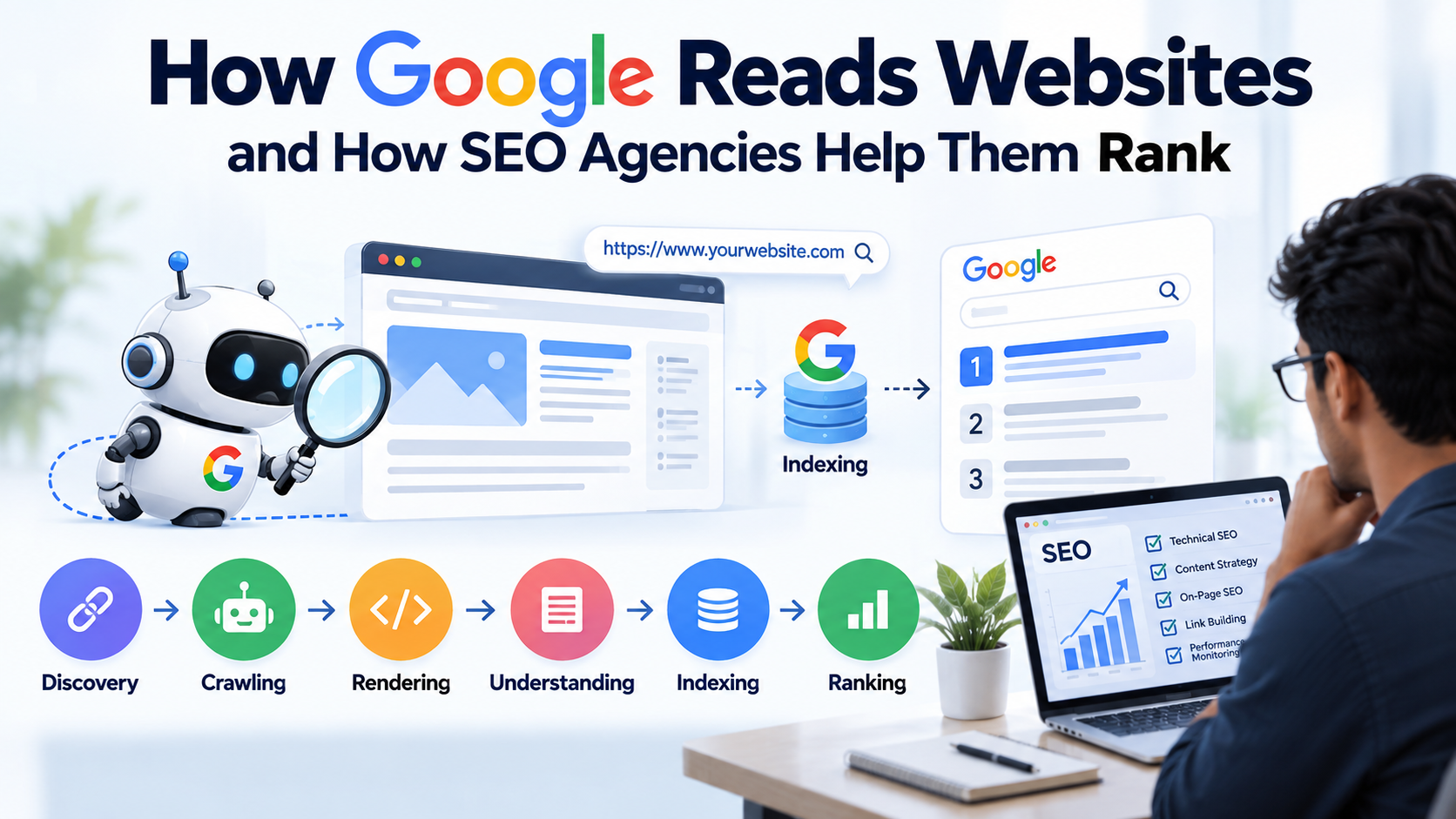
Google does not read a website exactly like a person. Its systems discover pages, crawl them, process their content, understand what they are about, and decide whether they should be included in the search index. When someone searches, Google evaluates relevant indexed pages and orders the results.
That is where an SEO agency can help: by checking whether important pages are accessible, making their purpose clearer, and improving what visitors find when they arrive.
A simple way to picture the process is:
Discovery → Crawling → Rendering → Understanding → Indexing → Ranking
Google may find a URL in a site’s own navigation, a link from another website, an XML sitemap, or a page it has visited before.
If the page sits several clicks away with no useful links pointing to it, both customers and Google may struggle to find it.
Once Google knows about a URL, Googlebot can visit it and retrieve resources such as HTML, CSS, JavaScript, and images.
A robots.txt rule might block a page by mistake. A link could lead to a 404 error, or the server might fail when Googlebot visits. Pages buried deep in the site can be missed, too.
An SEO audit checks these access problems and identifies the pages that need attention first.
Some websites load their main text or product details with JavaScript. Google can render many such pages, but the content still needs to load reliably.
Imagine a service page whose description appears only after a script runs. If that script fails, Google may see very little of the page. The SEO team and developers may need to investigate it together.
Finding a page is only the beginning. Google also needs to understand its subject. It can use signals such as:
The title helps set an expectation; the headings and body copy then need to explain the service in terms a potential customer can follow.
Using the same keyword in every sentence makes a page harder to read and adds little value.
These terms are often confused.
Crawling means Google has accessed a page.
Indexing means Google has processed the page and decided it can be included in its search index.
Ranking happens when Google evaluates relevant indexed pages for a particular search and orders the results.
So, a page being crawled does not guarantee that it will be indexed. Being indexed also does not guarantee high visibility.
Google weighs the relevance and usefulness of pages for each search, alongside other signals. There is no single switch that puts a page at the top.
Search intent is a key part of SEO.
“What is SEO?” is mainly informational.
“SEO agency in India” may come from someone researching a service.
A person looking for a basic explanation is unlikely to get much from a page that only asks them to book a sales call.
A useful page gets to the answer and includes enough detail to help someone take the next step.
Write the page for the person reading it. A clear title, sensible headings, and specific answers also help Google identify its subject.
An internal link might take a visitor from a general services page to a more detailed SEO page. That same link helps Google see how the two pages relate.
For example:
Homepage → Digital Marketing Services → SEO Services → SEO Blog
A long list of unrelated backlinks is unlikely to help readers. Links from relevant, credible pages are more useful.
An agency cannot promise to place a site first in Google. It can, however, find obstacles that keep good pages from being found or understood and improve the pages themselves.
An agency can look for:
The findings give the team a practical order of work, instead of a list of changes made at random.
The agency weighs what people search for against relevance, likely intent, competition, and the services the business wants to promote.
Those terms can then be mapped to the right pages.
A software company, for instance, could explain web development, mobile apps, custom software, and e-commerce services on separate pages. Each page can answer a different set of questions.
An agency can refine:
A clearer title or description can tell someone what to expect before they click. Better headings and page copy help once they arrive.
Depending on the website, an agency may work on:
This can be particularly important on large websites, where one structural issue may affect many URLs.
Customer conversations often reveal useful topics. An agency can turn recurring questions into articles that draw on what the business actually knows.
For a web development company, this could include:
Publishing another post just to meet a monthly quota rarely helps. Choose a question the audience really asks, then answer it with specific, useful detail.
Good internal links help someone continue reading without having to hunt through the menu.
A post about improving website speed, for example, could point to a technical SEO service page when that service would help the reader solve the problem.
The link belongs where the reader would reasonably expect more detail, rather than being added solely to push them toward a sales page.
After publishing, an agency can check Google Search Console and analytics to see whether people are finding the page. Useful measures include:
If impressions rise but clicks do not, the team might review the page title and the searches it appears for. A drop in indexed pages calls for a different investigation.
No agency can guarantee the top spot for a chosen search.
SEO can make pages more accessible and useful, but rankings also depend on the query, competing pages, and changes to the search results.
A more useful target is steady growth in relevant visits to pages that actually answer what potential customers need.
Google's process can be simplified to:
Discover → Crawl → Render → Understand → Index → Rank
Each step presents a different question: Can Google find the page? Can it read the content? Does the page answer the search?
An agency can address those questions through technical fixes, research into search intent, clearer page copy, helpful articles, internal links, and ongoing measurement.
Strong SEO work starts with a site people can use and search engines can reach. It continues with pages that answer real questions, plus regular checks on what is working and what needs to change.