 Loading Please Wait...
Loading Please Wait...
Loading Please Wait...
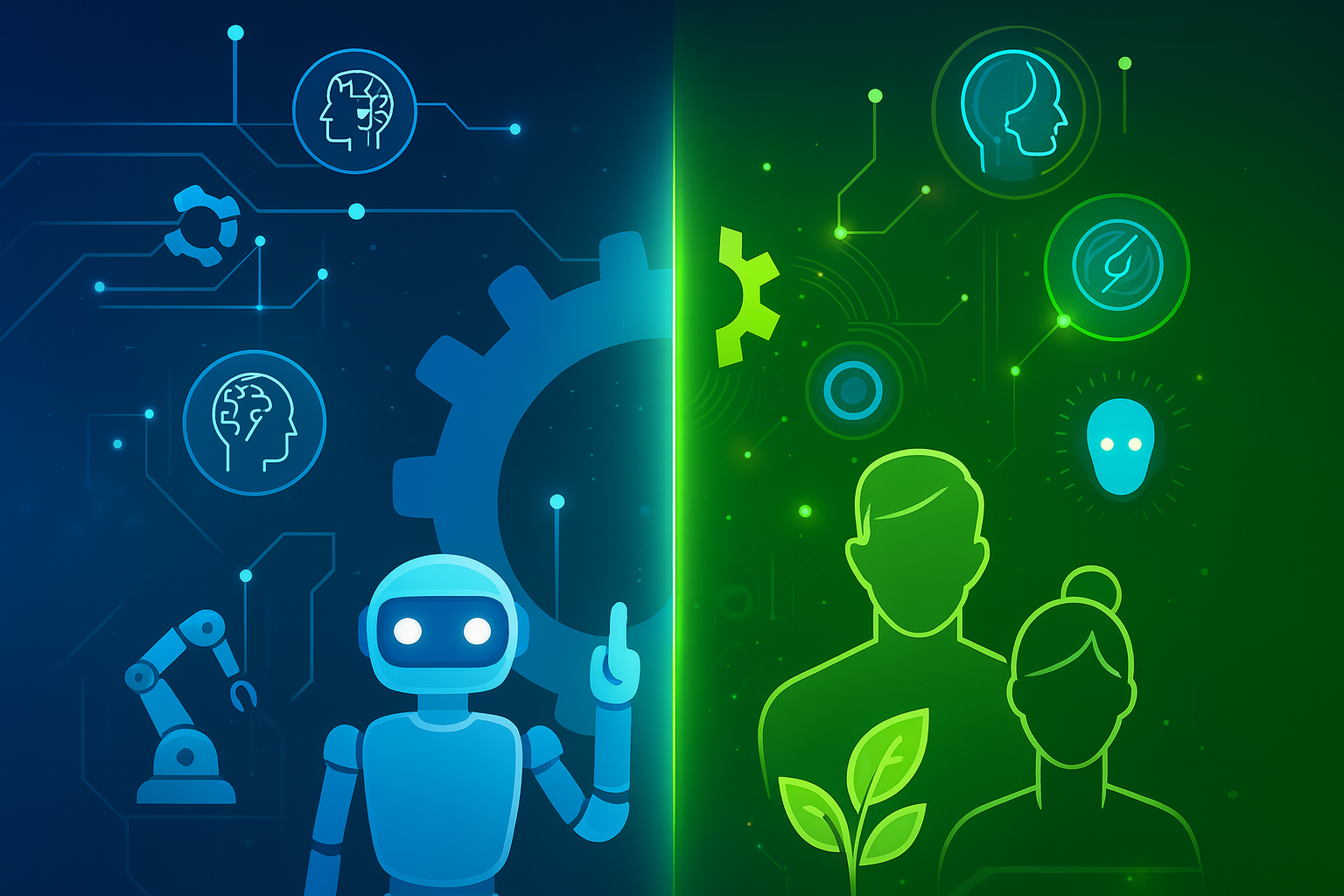
The fourth industrial revolution—commonly known as Industry 4.0—revolutionized the way businesses operated. It connected machines, people, and data in ways never before possible through automation, IoT, artificial intelligence, and big data. For years, Industry 4.0 has been synonymous with digital transformation and smart manufacturing.
But as technology evolved, so did our understanding of its impact on society. While Industry 4.0 focused on efficiency, speed, and automation, the next phase—Industry 5.0—emphasizes collaboration between humans and technology. It brings humanity back into the center of innovation.
In this blog, we’ll explore how Industry 5.0 differs from Industry 4.0, the technologies driving this transition, and why it represents a more sustainable, human-centric approach to the future of work and production.
Industry 4.0 marked the digital revolution of manufacturing and production. Coined in Germany in 2011, it was driven by the integration of advanced digital technologies into industrial processes.
The primary goal was efficiency, productivity, and precision. Smart factories became the hallmark of this era—self-monitoring, self-learning, and self-optimizing.
However, with rapid digitalization came new challenges: job displacement, sustainability concerns, and the risk of dehumanization in the workplace. This set the stage for Industry 5.0.
Industry 5.0 is the next evolution—where humans and machines work together harmoniously. Instead of replacing people, technology in Industry 5.0 enhances human creativity, empathy, and problem-solving.
Industry 5.0 can be defined as a human-centric, sustainable, and resilient approach to industrial production, emphasizing collaboration between human intelligence and machine precision.
While Industry 4.0 was machine-driven, Industry 5.0 is human-driven, technology-assisted.
| Aspect | Industry 4.0 | Industry 5.0 |
| Focus | Automation and efficiency | Human-machine collaboration |
| Goal | Productivity and cost reduction | Personalization, creativity, and sustainability |
| Human Role | Limited (machines lead) | Central (humans lead with tech support) |
| Technology Use | IoT, AI, robotics, big data | AI, cobots, ethical AI, sustainable tech |
| Values | Economic growth | Human welfare, social impact, and environment |
| Work Environment | Smart factories | Collaborative, human-centered environments |
In essence, Industry 4.0 built intelligent systems; Industry 5.0 gives them a soul.
The European Commission describes Industry 5.0 as being built on three main pillars:
Humans regain their central role in production. Machines handle repetitive tasks, while humans contribute creativity, ethics, and emotional intelligence.
For example, in a factory, collaborative robots (cobots) assist workers by handling heavy or dangerous tasks while humans focus on design, quality, and innovation.
Industry 5.0 promotes environmentally responsible production. Companies aim for:
COVID-19 highlighted the fragility of global supply chains. Industry 5.0 focuses on resilience—systems that can adapt quickly to change, supported by decentralized manufacturing and AI-driven decision-making.
The foundation of Industry 5.0 is built on Industry 4.0 technologies—but with more ethical, creative, and human-centric applications.
Unlike traditional robots that work independently, cobots are designed to work alongside humans safely. They combine precision and strength with human guidance and creativity.
AI is used not just for automation but to enhance human decision-making, predict maintenance issues, and personalize manufacturing.
These reduce latency and process massive data sets faster, enabling real-time decision-making and optimization.
From renewable energy integration to energy-efficient systems, sustainability tech reduces the environmental footprint.
Virtual replicas of physical systems allow testing, optimization, and predictive maintenance without real-world risks.
An evolution of IoT, IoB focuses on understanding human behavior and using insights to design more user-friendly systems.
Provides transparency and traceability in supply chains, ensuring ethical sourcing and responsible production.
Automation replaced millions of repetitive jobs but created new challenges like alienation and skill gaps. Industry 5.0 seeks to restore purpose by combining human strengths—creativity, empathy, and intuition—with machine efficiency.
Climate change and resource scarcity have made sustainability a top priority. Consumers now demand eco-conscious brands and sustainable manufacturing processes.
Pandemics, trade disruptions, and natural disasters revealed weaknesses in global supply chains. Industry 5.0 focuses on adaptability and local resilience.
Modern customers expect tailored products and services. Industry 5.0 enables mass customization—producing personalized goods at scale using advanced automation guided by human design.
As AI influences decisions from hiring to production, ethical considerations are becoming critical. Industry 5.0 promotes transparent and fair AI systems.
Rather than replacing people, technology enhances human potential, creativity, and satisfaction.
Eco-friendly production reduces energy consumption and waste, aligning with global sustainability goals.
Businesses can adapt faster to market disruptions and demand fluctuations.
Combining AI precision with human intuition ensures superior product quality and design.
Consumers favor brands that value people and the planet—Industry 5.0 supports both.
Despite its promise, transitioning from Industry 4.0 to 5.0 comes with hurdles:
Tesla’s factories combine automation with human expertise. Robots handle repetitive assembly, while humans oversee design and innovation—an early example of Industry 5.0 collaboration.
Siemens integrates AI and IoT in its manufacturing processes but focuses heavily on sustainable production and employee empowerment.
A pioneer in collaborative robotics, Universal Robots designs cobots that assist workers in complex tasks safely, improving productivity and morale.
P&G’s smart factories blend data analytics with human oversight to improve efficiency and sustainability in global operations.
The heart of Industry 5.0 lies in redefining the relationship between people and technology. Humans are no longer just operators—they’re creators, innovators, and ethical stewards.
This symbiotic relationship makes organizations more adaptable and humane.
Businesses can prepare for this next revolution by focusing on three areas:
Invest in digital literacy, robotics, AI, and sustainability training. Encourage interdisciplinary learning combining technology and creativity.
Adopt circular economy models, renewable energy, and carbon-reduction initiatives. Sustainability should become a core business metric.
Deploy cobots, AI assistants, and augmented reality tools that enhance human capabilities rather than replace them.
The evolution toward Industry 5.0 is not about rejecting automation but about humanizing it. It represents a shift from efficiency-centered growth to purpose-driven innovation.
In the future, factories will not just be smart—they’ll be sensitive to human needs, sustainable by design, and resilient to change. Workers will collaborate seamlessly with intelligent systems, and production will serve both economic and environmental goals.
Industry 5.0 marks the dawn of a new industrial mindset: one that values humans, the planet, and progress in equal measure.
The journey from Industry 4.0 to Industry 5.0 is more than just a technological upgrade—it’s a philosophical transformation. While Industry 4.0 focused on smart machines, Industry 5.0 focuses on smart collaboration.
This shift acknowledges that technology should serve humanity, not replace it. By embracing human creativity, ethical AI, and sustainable innovation, organizations can create a future where progress benefits everyone—not just productivity metrics.
In short, Industry 5.0 is not just about the next revolution in technology—it’s about the evolution of humanity within it.