 Loading Please Wait...
Loading Please Wait...
Loading Please Wait...
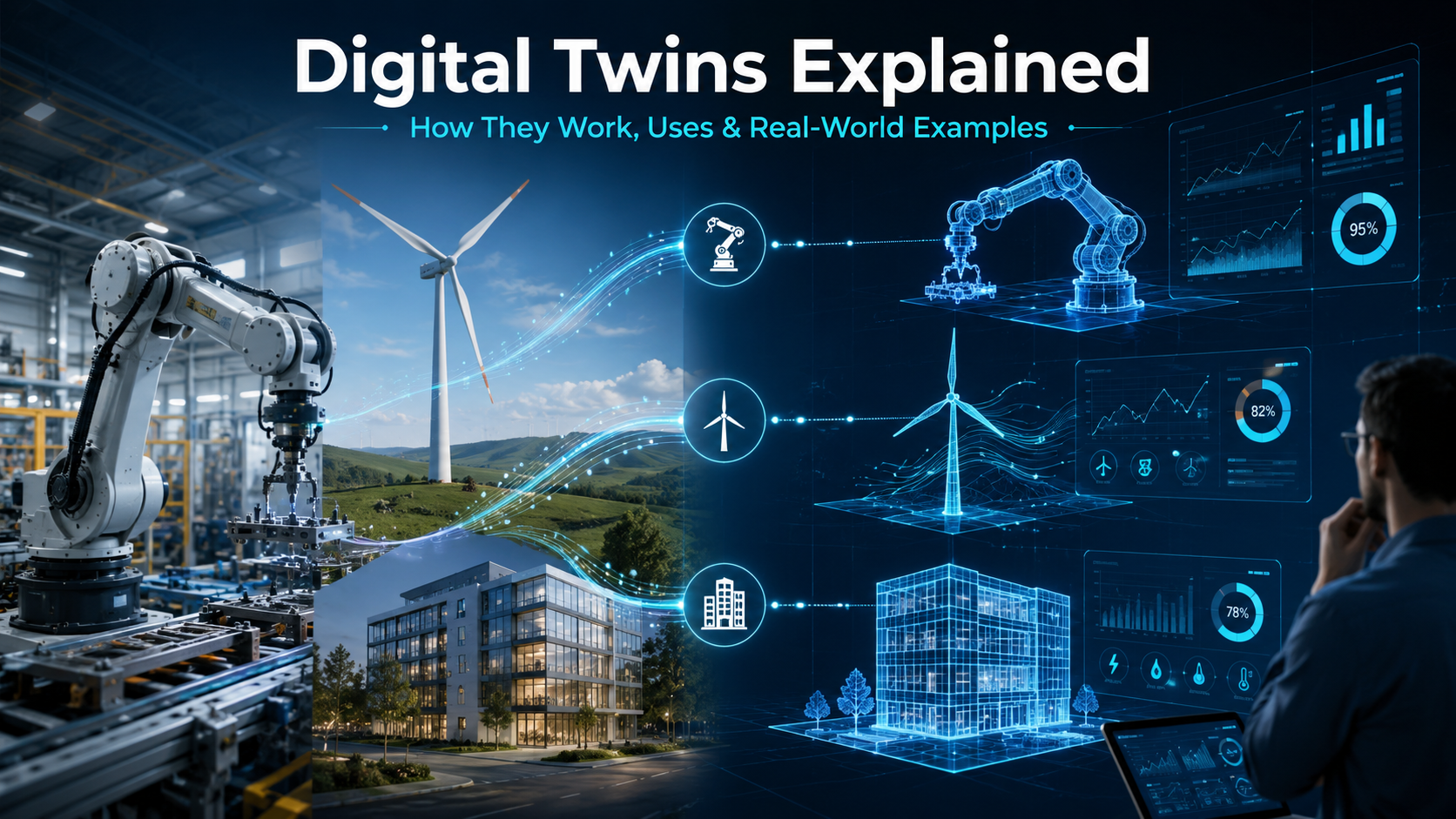
Imagine knowing that a factory machine may fail before it stops working, or testing a new production line without moving real equipment. Digital twin technology makes this possible by connecting physical systems with virtual models.
Digital twins are used in manufacturing, aerospace, buildings, energy and city planning. This beginner-friendly guide explains what a digital twin is, how it works, its most useful applications and how organisations are using it in the real world.
A digital twin is a virtual representation of a real object, process, system or environment. It receives data from its physical counterpart so it can reflect its current condition and behaviour.
A simple way to understand it is:
Physical object + real-world data + virtual model = digital twin
For example, sensors on a factory motor can collect temperature, speed, vibration and energy data. That information is sent to a virtual model, allowing engineers to monitor the motor and detect unusual behaviour.
A digital twin is not always a detailed 3D image. It may be a dashboard, mathematical model, simulation or a combination of these. What makes it a twin is its connection to the real system. Singapore’s Infocomm Media Development Authority describes the technology as a virtual version of a physical asset, system or process built with real-time, operational and historical data.
Most digital twins have five basic parts:
Consider a wind turbine. Sensors measure blade speed, temperature and vibration. Its digital twin compares this data with expected performance. When the vibration pattern becomes unusual, the operator can inspect the turbine before a serious failure occurs.
A 3D model mainly shows what an object looks like. A simulation tests what may happen under selected conditions. A digital twin can include both, but it is connected to a real asset through data.
This connection helps answer practical questions:
Teams can monitor the condition and performance of equipment from one place, even when assets are spread across factories, buildings or energy sites.
For example, a company can monitor the temperature and energy consumption of machines across several factories through one digital platform.
Operating data can reveal warning signs before equipment fails. This helps reduce unexpected downtime and allows maintenance teams to focus on assets that need attention.
Instead of repairing a machine after it breaks, the company can schedule maintenance when the digital twin detects unusual vibration, heat or pressure.
Engineers can test product designs, factory layouts and operating conditions before changing the physical system. This lowers the risk of costly mistakes and makes experimentation safer.
A manufacturer could test whether a new robot would collide with existing equipment before installing it on the production floor.
A digital twin can reveal where a process is slow, wasteful or using too much energy. Teams can compare different settings virtually and apply the most promising change in the real world.
Building managers, for example, can analyse temperature, occupancy and electricity data to improve heating, cooling and lighting systems.
Workers can practise difficult procedures in a virtual environment. Organisations can also simulate equipment failures, traffic changes or emergencies without creating real danger.
This can be useful for factory workers, aircraft engineers, emergency teams and employees who operate expensive or hazardous equipment.
BMW uses digital twins for production planning across more than 30 production sites. Its Virtual Factory allows teams to simulate changes that once required physical modifications and testing. BMW also uses the environment for production planning and automated collision checks before product launches.
This example shows how a digital twin can help plan how people, robots, equipment and materials will work together before a factory change is implemented.
NASA applies digital-twin approaches to spacecraft, aircraft operations and Earth-system research. Its JSTAR software digital twins emulate hardware, allowing teams to expand testing without depending entirely on physical equipment.
NASA also highlights how sensor technology, scientific computing and artificial intelligence can make digital twins more useful for decision-making and risk reduction.
For space missions, virtual testing is especially valuable because physical equipment may be expensive, difficult to access or impossible to repair after launch.
Virtual Singapore is a data-rich 3D model that supports urban planning and simulations using information such as environmental data.
In March 2025, Singapore also launched a Maritime Digital Twin of its port, developed by the Maritime and Port Authority and GovTech.
These projects demonstrate that digital twins can represent not only individual products and machines but also cities, ports and infrastructure networks.
The main benefits of digital twins include better visibility, earlier problem detection, safer testing, faster planning and stronger decision-making. They can also help organisations reduce waste and improve the use of equipment and energy.
However, a useful digital twin requires accurate data, suitable sensors, secure connectivity and a clear objective. Poor-quality data can produce misleading results.
Other common challenges include:
The best approach is to begin with a specific problem instead of trying to create a digital twin of everything.
Coding is not always necessary for a basic digital twin project. Low-code and no-code tools can connect sensor data to dashboards, alerts and pre-built visualisations.
Advanced digital twins usually require programming and specialist knowledge. Python may be used for data analysis and prediction, JavaScript for dashboards, SQL for data management, and cloud or IoT tools for device connections.
A beginner could start with a digital twin of a room. Temperature and humidity sensors could send information to an online dashboard, while alerts could be triggered when the room becomes too hot.
Start with one asset and one useful question, such as:
“Can we identify when this motor begins to overheat?”
Next, decide which data is required, connect the relevant sensors, build a simple dashboard or model, and test whether the information supports better decisions.
Once the project creates measurable value, more assets, simulations or AI features can be added.
Digital twins help organisations understand real systems through virtual models. By combining physical assets, data, software and analysis, they can monitor performance, predict problems and test improvements before applying them in the real world.
The technology can range from a simple room-monitoring dashboard to a virtual factory, spacecraft system or city.
A successful digital twin does not need to be the largest or most visually impressive. It needs to solve a real problem with reliable data.